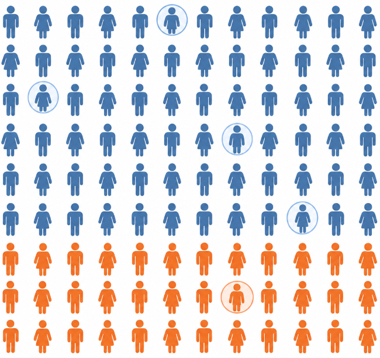


When evaluating the representation of immigrants in crime statistics, variables such as age, gender, income, education, and the region of residence must be taken into account.
Migration has been one of the most contentious political and social issues in Europe in recent years. In particular, the claim that immigrants increase crime rates is frequently raised in public discourse (https://www.dw.com/tr/almanyada-ger%C3%A7ekten-yabanc%C4%B1lar-daha-m%C4%B1-%C3%A7ok-su%C3%A7-i%C5%9Fliyor/a-79657016). While some argue that migration is a security issue—pointing to the higher representation of immigrants in crime statistics—others contend that such claims stem from prejudice. Is there truly a link between migration and crime?
There is an important principle to keep in mind: the existence of a statistical correlation between two variables does not imply that one causes the other.
According to the 2025 police crime statistics from the German Federal Criminal Police Office (Bundeskriminalamt, BKA), 35.5% of crime suspects are non-German citizens—a figure that excludes violations of immigration law. Regarding violent crimes, the share of foreign nationals among suspects reaches 42.9% (https://www.bundesregierung.de/breg-de/aktuelles/polizeiliche-kriminalstatistik-2025-2422020).
These proportions are significantly higher than the share of foreign nationals in Germany’s total population. However, one cannot conclude from these statistics that immigrants are inherently more prone to committing crimes. It is necessary to understand what these figures actually measure and which factors influence them.
First and foremost, police statistics reflect individuals recorded as suspected of committing a crime, rather than those whose guilt has been established by a court. Not every crime is reported to the police, not every suspect is ultimately found guilty, and police oversight may not be distributed equally across all segments of society. Furthermore, factors such as age, gender, economic status, and the area of residence can all influence crime statistics.
Comparing groups with different characteristics can lead to misinterpretation of the results. For this reason, researchers strive to account for variables—such as age, gender, income, education, and place of residence—in their statistical analyses. For instance, young men are generally more likely to be recorded as suspects in crimes than women or older individuals. The proportion of young men within an immigrant population may also be higher than in the native-born population.
In such a scenario, comparing only the overall crime suspicion rates of two groups is misleading. A more accurate assessment requires comparisons between individuals of similar age and gender.
A similar logic applies to the place of residence. Crime rates in large cities may be higher than in rural areas. Since immigrants often reside in major urban centers, a portion of the observed relationship between immigration and crime may, in fact, stem from the environment in which they live.
In statistics, the process of accounting for the influence of such variables is known as “adjustment.” In a study published in 2025, researchers Jean-Victor Alipour and Joop Age Harm Adema from the Munich-based ifo Institute examined police crime statistics in Germany at the district level for the years 2018–2023 (https://www.ifo.de/publikationen/2025/aufsatz-zeitschrift/steigert-migration-die-kriminalitaet-ein-datenbasierter-blick).
The researchers sought to answer a key question: Does an increase in the foreign-born population in a given area lead to higher crime rates there?
The findings were notable: no systematic statistical relationship was found between increases in the foreign-born population and rising crime rates across districts. Similar results were observed regarding asylum seekers. Furthermore, the study found no systematic link between an increase in the foreign-born population and serious crimes, such as homicide or sexual assault.
According to the researchers, one significant explanation for the higher representation of foreign nationals in crime statistics is that immigrants tend to be concentrated in large urban centers, where crime rates are generally higher. Differences in age and gender distribution also play a role; however, in this study, the influence of regional factors was particularly pronounced.
To better understand these findings from Germany, we can also look at research conducted in other countries.
In the United States, a study by Abramitzky et al., published in 2024 in the journal American Economic Review: Insights, analyzes 150 years of census data spanning from 1870 to 2020 (https://www.aeaweb.org/articles?id=10.1257%2Faeri.20230459). According to the research, incarceration rates for immigrants remained lower than those for U.S.-born individuals throughout the period studied. Today, immigrants are approximately 60% less likely to be in prison than those born in the U.S.
United Kingdom: According to an assessment published by the Migration Observatory at the University of Oxford in August 2026, 13.1% of individuals who received a formal caution or conviction in England and Wales in 2024 were foreign nationals. Foreign nationals accounted for approximately 13.5% of the adult population. When age differences are taken into account, the representation of foreign nationals in the criminal justice system appears even lower (https://migrationobservatory.ox.ac.uk/resources/briefings/migrants-and-crime-in-the-uk/).
Sweden: Research published in 2021 by the Swedish National Council for Crime Prevention (Brå) presents a different picture. The study found that individuals born outside Sweden were approximately 2.5 times more likely to be registered as suspects in a crime than individuals born in Sweden whose parents were both born in Sweden. For individuals born in Sweden whose parents were both born abroad, this figure was approximately 3.2 times higher (https://bra.se/english/publications/archive/2021-08-25-registered-offending-among-persons-of-native-and-non-native-background).
The researchers noted that when adjustments were made for factors such as age, gender, income, education, and place of residence, the disparities between the groups decreased significantly, though they did not disappear entirely.
Denmark: Official integration statistics in Denmark also indicate higher crime rates among certain immigrant groups. According to 2025 data, the age-adjusted index of criminal convictions—under the penal code—among male migrants from MENAPT countries (including the Middle East, North Africa, Pakistan, and Türkiye) was approximately twice the average for the total male population. For the sons of this same group who were born in Denmark, this figure was roughly three times higher (https://integrationsbarometer.dk/tal-og-analyser/kriminalitet).
When these studies are considered together, three significant conclusions emerge.
First, migrants or foreign nationals do not exhibit the same crime statistics across all countries. Furthermore, it is important to note that the crime indicators used by different countries are not directly comparable.
Second, adjustments for demographic and socioeconomic factors can substantially alter the results. In particular, comparisons that fail to account for variables such as age, gender, economic status, and place of residence may misrepresent the strength of the relationship between crime and migration.
Third, the overrepresentation of a specific migrant group in crime statistics is not the same as migration causing an increase in a country’s overall crime rate. Assessing the societal impact of migration requires research that examines changes over time and the nuances among different migrant groups and types of crime.
In this discussion, we must avoid two pitfalls: ignoring statistical disparities and attributing these differences to migrants’ identities without investigating the underlying causes.
Protecting the safety of crime victims and preventing criminal activity is in the common interest of all members of society, including migrants. Therefore, in the effort to combat crime, it is essential to understand which conditions increase risk and which reduce it. In this regard, areas such as education, employment, housing, social integration, and the environmental conditions where crime is concentrated are worth investigating.