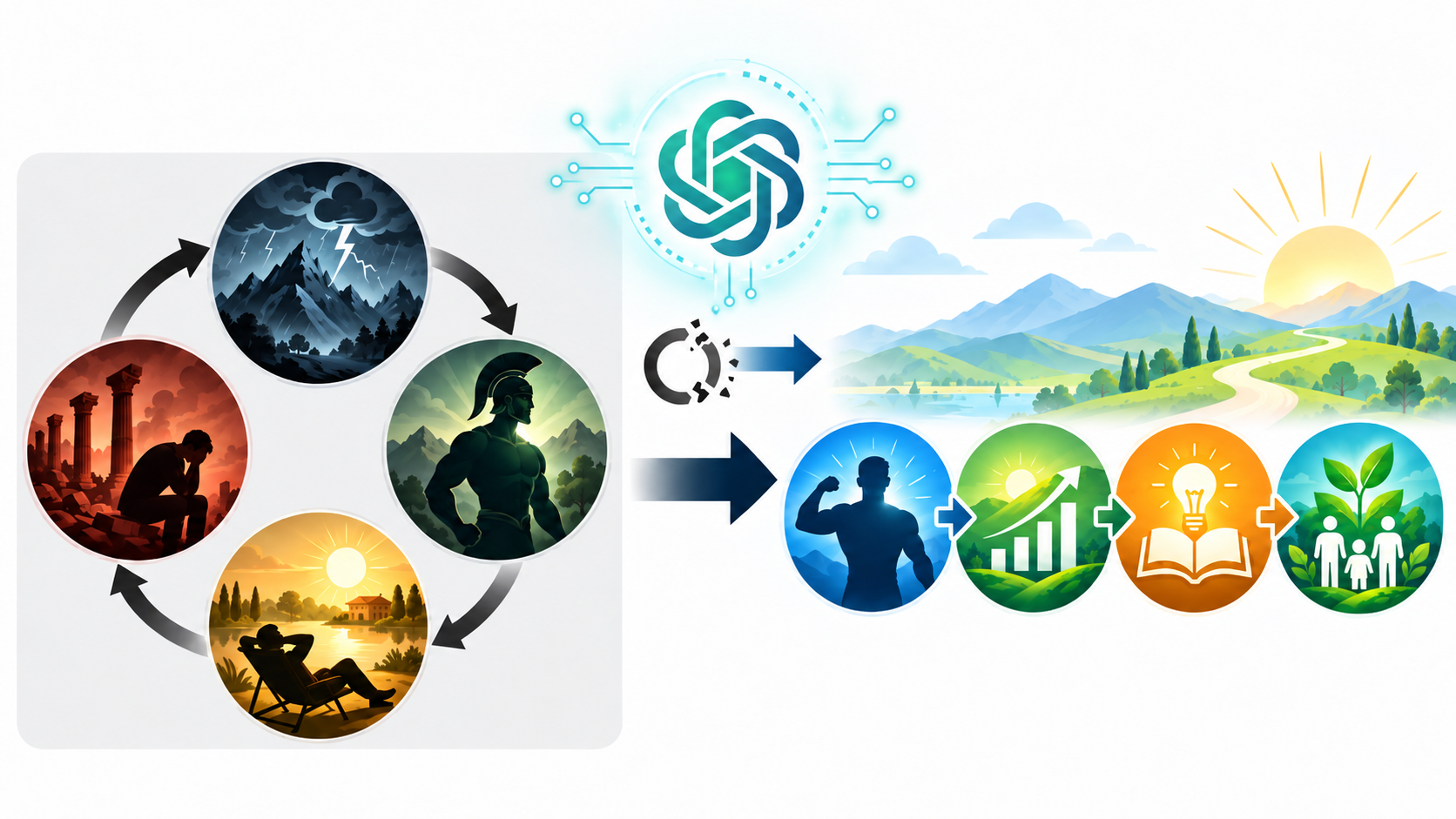


Hard times create strong men.
Strong men create good times.
Good times create weak men.
And weak men create hard times. (Michael Hopf)
Michael Hopf’s analogy goes like this: Hard times forge strong people; strong people create good times; good times lead to the emergence of weak people; and weak people, in turn, bring about hard times. Building on this, we might ask: Is the era of artificial intelligence making humans weaker?
Throughout history, humanity has developed technology to make life easier. We have delegated heavy labor to machines, accelerated transportation, and entrusted calculations to computers. Today, thanks to artificial intelligence (AI), we are offloading a significant portion of our mental activities to technology.
We can now generate reports in minutes—tasks that once required hours of research. Students, academics, and professionals across many fields are leveraging artificial intelligence. Moreover, this is no longer merely a choice; it has become a necessity imposed by the demands of competition.
Yet, this development raises a critical question: As humanity delegates the act of thinking to machines, could we be losing our own capacity to think?
The human body and mind develop by adapting to the challenges they encounter. If we do not use our muscles, they weaken. Similarly, exercising our memory, solving problems, and engaging in deep, focused thought contribute to the development of our cognitive abilities.
In the past, we would memorize phone numbers, study maps to find our way, and compare various sources to acquire information. Today, technological tools handle most of these tasks for us. Certainly, we are not obligated to memorize unnecessary information. However, there is a distinct difference between not needing to use a skill and becoming incapable of using it when the need arises.
In an experiment involving approximately 1,000 high school students, it was found that assistance similar to ChatGPT improved students’ performance in solving mathematics problems by 48%. Yet, when this AI support was removed, the students’ performance on independent tests dropped to 17% below that of a group that had never used AI. In contrast, a specialized AI tutor—which guides students rather than providing direct answers—increased success during practice by 127% without causing the same negative impact on independent testing (https://doi.org/10.1073/pnas.2422633122).
In another experiment, 120 university students were divided into two groups. In an unannounced recall test administered 45 days after the learning phase, those who had used ChatGPT achieved a 58% success rate, compared to 69% for those who had studied using traditional methods (https://doi.org/10.1016/j.ssaho.2025.102287).
These studies do not prove that AI causes a general decline in human intelligence. They do, however, point to a significant danger: being able to solve a problem with the help of artificial intelligence is not the same as learning how to solve that problem independently.
Furthermore, the OECD’s PISA 2022 study revealed that students who used digital tools for educational purposes at school for up to one hour per day scored, on average, 24 points higher in mathematics than those who did not use such tools at all. Conversely, approximately 30% of students reported that their attention was distracted by digital tools during mathematics lessons (https://www.oecd.org/en/publications/pisa-2022-results-volume-ii_a97db61c-en.html).
These findings highlight the importance of using technology in a measured and purposeful manner.
In the past, concerns were raised that writing might weaken memory and that calculators might diminish mathematical skills. Yet, it remains a fact that new technologies enable new ways of thinking and creating.
In the age of AI, asking the right questions, evaluating sources, and solving complex problems may become more significant than memorizing information.
However, critical thinking is difficult without a foundation of basic knowledge. How could someone who lacks sufficient knowledge of a subject identify incorrect answers provided by artificial intelligence?
The individual of the future must be someone who not only has access to information but also understands it, questions it, and can make independent decisions.
While Michael Hopf’s famous statement serves as a striking metaphor, it is not a proven historical law. Wars and poverty do not always produce strong individuals. Conversely, prosperity and security can foster scientific and cultural progress.
Therefore, the issue is not the existence of “good times,” but rather how to maintain the efforts and responsibilities that foster human development during such periods.
In the past, people were compelled to endure many hardships. Today, however, we must consciously choose to embrace certain challenges that facilitate our own growth.
As our need for physical labor has decreased, we have turned to sports; we lift weights, run, and swim to build muscle. We are reintroducing, in a controlled manner, the physical effort that technology has diminished for the sake of our health.
We can adopt a similar approach for our minds: we can attempt to solve a problem ourselves before asking AI, read an article before having it summarized, and formulate our own thoughts before having a text written for us.
Instead of asking artificial intelligence for a direct answer, we could say, “Guide me without giving me the solution,” or “Point out the weak spots in my reasoning.”
In this way, AI can become a tool that deepens our thinking rather than a substitute for it.
In the age of AI, producing a flawless assignment does not necessarily prove that the subject matter has been truly learned. Educational institutions should evaluate the learning process, not just the final product.
In this context, oral exams, discussions, independent problem-solving, and having students explain their own thought processes are regaining their importance.
If AI allows us to complete a task in one hour that previously took five, will we use that saved time simply to do more work? Or might we also dedicate it to learning, research, the arts, sports, and contributing to society?
It is possible to break the cycle mentioned by Hopf. By leveraging the favorable conditions created by capable individuals, we can foster generations that are even stronger, more knowledgeable, and more responsible. This can be achieved through conscious education, voluntary effort, and by harnessing technology to serve human development. The core issue is not how intelligent machines have become, but rather how much humans can develop with their assistance. As we utilize technology, we must also teach the importance of preserving the ability to think independently.