
Ownership entails responsibility. Is the right to property absolute, or does the wealth one possesses bring with it certain obligations toward society? Where does an individual’s right to earn more end, and where does society’s demand for fairer distribution begin?
Let us imagine a country inhabited by one hundred people. Suppose that 90% of all the houses, plots of land, factories, companies, and financial assets in the country belong to just five individuals, while the remaining 95 people share the remaining 10%.
Does the fact that these five individuals earned their wealth honestly suffice to make this scenario fair? Where does the right to property end, and where does the public interest begin? And should the state intervene in such a distribution?
Even if no one in a society goes hungry, and everyone has a roof over their head and access to basic healthcare, the concentration of the vast majority of wealth in the hands of a small group remains a matter for debate. This is because money provides more than just the means for greater consumption; beyond a certain level, economic power translates into access to educational opportunities, companies, real estate, and the media—and, indirectly, to social and political influence.
Europe is one of the regions with a relatively balanced income distribution globally. Yet, even here, inequality has not been eliminated. According to Eurostat data, the disposable income of the top 20% of earners in the European Union was approximately five times that of the bottom 20% in 2010. By 2024, this ratio had fallen to 4.6. In other words, a limited but distinct reduction in income inequality has been observed across Europe in recent years (https://ec.europa.eu/eurostat/statistics-explained/SEPDF/cache/63344.pdf).
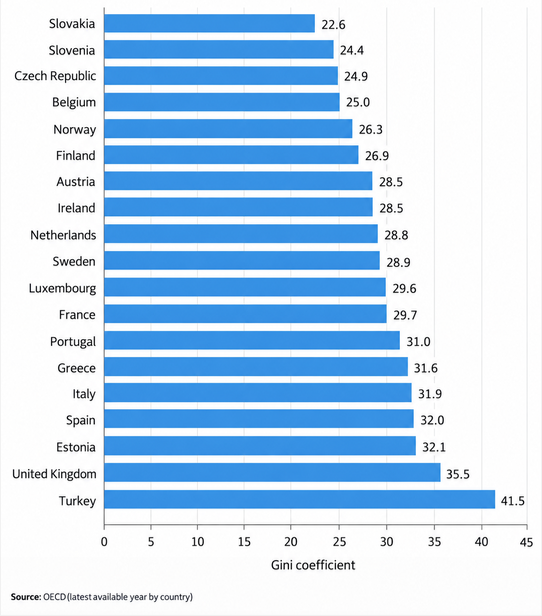
The Gini coefficient is one of the most common indicators used to measure inequality in income distribution. When expressed on a scale of 0 to 100, a value of 0 represents perfect equality—where everyone has the same income—while 100 represents a state of extreme inequality where all income is concentrated in the hands of a single person (https://en.wikipedia.org/wiki/Gini_coefficient).
In 2024, the EU’s Gini coefficient stood at 29.4. That same year, the top 10% of earners received 23.3% of the total disposable income. The impact of the welfare state is clearly evident here: the Gini coefficient drops from 34.3—before accounting for social transfers—to 29.4 after such transfers. This demonstrates that the relatively low level of inequality in Europe is not merely a natural outcome of market forces; rather, tax, social security, and transfer mechanisms significantly alter income distribution (https://ec.europa.eu/employment_social/employment_analysis/esde/2026/Chapter%201.html).
A “pie” analogy can help make this easier to understand. If the total income generated in a year is fixed, an increase in one group’s share of the pie mathematically results in a decrease in the shares of others. However, the economy itself is not static; production can increase, and the pie can grow. Indeed, real household income per capita in the EU rose by approximately 22% between 2004 and 2024. Therefore, becoming wealthy does not always mean someone else is becoming poorer (https://ec.europa.eu/eurostat/web/products-eurostat-news/w/ddn-20251125-2).
However, the approach of “let’s just keep growing the pie and not discuss distribution” has its limits. Although economic value is not derived solely from natural resources, a significant portion of production and consumption relies on energy, raw materials, and ecological systems. The European Environment Agency reports that approximately 14 tonnes of material are used per person annually in Europe and that current resource use exceeds sustainable limits. While the EU economy has managed to keep total material use largely stable even as it has grown in recent years, this decoupling remains limited (https://www.eea.europa.eu/en/analysis/publications/europes-circular-economy-in-facts).
Consequently, economic growth is not a limitless solution that renders the debate on income distribution unnecessary.
So, should a direct limit be placed on the accumulation of excessive wealth? Theoretically, one could consider banning an individual from possessing wealth exceeding 10 million, 100 million, or 10 billion euros; however, the model implemented in European countries generally does not work that way. Instead, the preference is to increase tax rates as income rises.
Germany is a well-known example of this. In 2026, the first €12,348 of taxable income will be exempt from income tax. The rate then rises progressively; the marginal rate reaches 42% in the high-income bracket and 45% for the portion exceeding €277,826. The crucial detail here is that a high-income earner’s entire income is not taxed at a rate of 45%; The higher rate applies only to the portion of income falling within that bracket (https://esth.bundesfinanzministerium.de/lsth/2026/A-Einkommensteuergesetz/IV-Tarif-31-34b/Paragraf-32a/inhalt.html).
The underlying idea of this system is simple: one hundred euros does not hold the same significance for someone forced to spend the bulk of their monthly income on rent, food, and energy as it does for someone with a very high income. Consequently, increasing the tax burden in line with the ability to pay is one of the primary redistribution tools employed by modern welfare states.
However, the system is not as straightforward as it appears on paper. Individuals with very high incomes and vast wealth often have access to corporate structures, investments, assets across multiple jurisdictions, inheritance arrangements, and tax exemptions far beyond the reach of ordinary wage earners. The OECD points out, for instance, that certain exemptions regarding inheritance and gift taxes in Germany reduce the effective tax burden, particularly for wealthy households. The same report notes that wealth inequality in Germany is high and that taxing wealth transfers could be significant for ensuring equal opportunity (https://www.oecd.org/de/publications/oecd-wirtschaftsberichte-deutschland-2023_80df9211-de/full-report/component-4.html).
On the other hand, the impact of high taxes on investment, entrepreneurship, capital flows, and tax avoidance constitutes the other side of this debate.
In this context, the Islamic concept of *zakat* offers an interesting example. *Zakat* is conceived not merely as voluntary charity, but as a portion of wealth—meeting specific criteria—that must be allocated to the more needy segments of society. While the underlying concept differs from that of the modern progressive income tax, both share a fundamental question: Is an individual’s right to property absolute, or does the possession of wealth entail certain responsibilities toward society?
The real issue is not wealth itself, but the point at which wealth transforms into social power. An individual living in a better home, traveling more comfortably, or providing greater opportunities for their children is not the same as controlling a fortune equivalent to the economic resources of thousands of people.
Therefore, there is no simple numerical answer to the question, “How much wealth is too much?” To what extent can a society accept the concentration of economic power in the hands of an increasingly small group while still protecting an individual’s freedom to work, produce, invest, and accumulate wealth? Where does an individual’s right to earn more end, and where does society’s demand for fairer distribution begin? People across the globe must debate these questions and devise shared solutions.
Moreover, this is no longer a problem that individual states can solve on their own. While capital, corporations, and wealth easily cross national borders, tax systems and social policies largely remain confined to the national level. When one country attempts to levy higher taxes on high incomes or vast fortunes, capital can migrate to other countries or be shifted into different legal structures. Consequently, achieving a fairer distribution of income and wealth requires not only national policies but also stronger international cooperation, tax transparency, and common minimum standards.
Yet, even the best laws and tax systems may not suffice on their own. Ultimately, it is people who establish and implement these systems—and who seek ways to circumvent them. Thus, the issue is not merely one of economics or law; it is also a matter of conscience. An individual certainly has the right to earn more. However, when one possesses wealth far exceeding one’s needs, one must also ask oneself: How much of this wealth is truly necessary for me, and how much could be used to improve the lives of others?
A more humane economic order can be achieved not merely through rules that limit wealth, but through a culture that values sharing. Solidarity cannot be established through compulsion alone. Voluntary sharing—whether through zakat, charitable donations, the tradition of endowments (waqf), modern philanthropy, or other forms—reflects how diverse cultures have expressed the same fundamental idea for centuries: to possess is also to bear responsibility.